
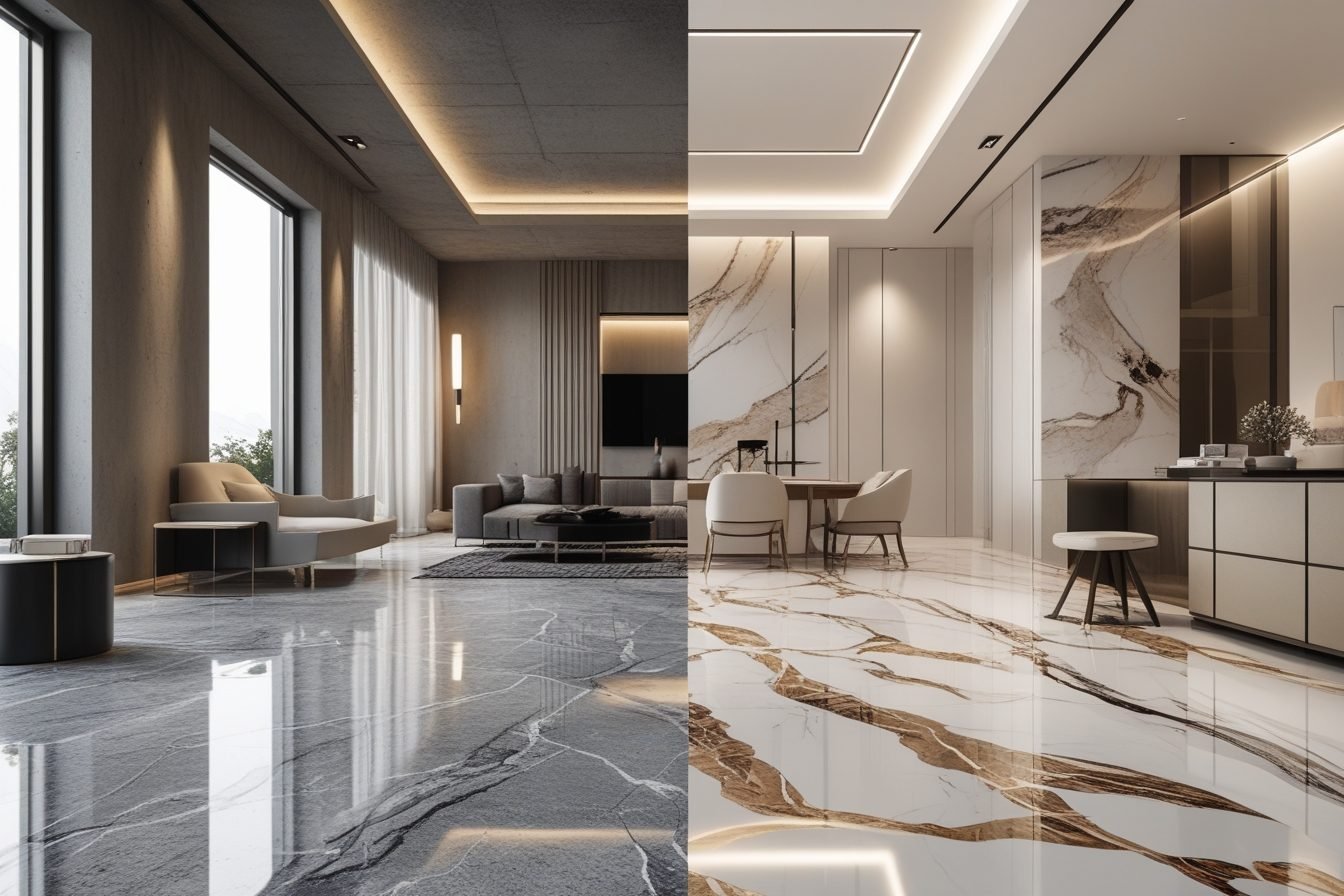
Almost every project starts with this question, and it is usually asked as though one stone is simply better than the other. It is not. Marble and granite fail in different ways, and the right choice depends far more on the room and the household than on any ranking of the two materials.
They are not the same kind of rock
Marble is metamorphic. It begins as limestone and is recrystallised by heat and pressure, which is where the veining comes from — those are mineral impurities smeared through the stone as it re-formed. Chemically it is largely calcium carbonate, and that single fact explains most of its behaviour.
Granite is igneous. It cooled slowly from molten rock, and its speckled appearance is interlocking crystals of quartz, feldspar and mica. Quartz sits at 7 on the Mohs hardness scale. Calcite, the main mineral in marble, sits at 3.
Everything below follows from that gap. Granite resists scratching and acid; marble resists neither, and asks for a different kind of care in return for a look granite cannot produce.
The kitchen problem: acid, not hardness
Most people worry about scratches. In a kitchen, the more common damage is etching, and it is a chemical reaction rather than a mechanical one. Lemon juice, vinegar, tomato, wine and many household cleaners are acidic enough to dissolve a microscopic layer of calcium carbonate where they sit. The result is a dull mark on a polished marble surface — not a stain sitting on top of the stone, but a patch where the polish has been eaten away.
A sealer does not prevent this. Penetrating sealers reduce absorption, which helps with staining, but they do not stand between an acid and the calcite. This is the single most useful thing to understand before putting marble on a kitchen counter.
Granite is a silicate and does not react this way. Its weakness is oil: an unsealed or under-sealed granite can darken where cooking oil soaks in, which is why granite counters want re-sealing periodically rather than never.
Side by side
| Marble | Granite | |
|---|---|---|
| Hardness (Mohs) | About 3–5 | About 6–7 |
| Reacts with acid | Yes — etches visibly | No |
| Absorbs oil and liquid | Moderate to high | Low to moderate |
| Heat | Tolerates hot pans | Tolerates hot pans |
| Pattern | Flowing veins, can be book-matched | Speckled and granular, more uniform |
| Repolishing | Possible on site | Harder, usually specialist work |
| Best suited to | Floors, walls, bathrooms, low-traffic surfaces | Kitchen counters, high-traffic floors, exteriors |
Where marble wins
Nothing else looks like a large marble floor with the veining running continuously across it. Because slabs are cut sequentially from the same block, adjacent pieces can be laid as mirror images — book-matching — so a wall or floor reads as one piece of stone rather than an assembly of tiles. Manufactured surfaces imitate this, and it never quite holds up at scale.
Marble is also a comfortable floor in an Indian summer. It stays cool underfoot, and a honed or leather finish hides day-to-day marks far better than a high polish, which is worth considering for a busy house.
For living rooms, bedrooms, lobbies, feature walls and bathroom vanities, marble is generally the better answer.
Where granite wins
Anywhere the surface will be worked on rather than looked at. Kitchen counters take knives, hot vessels, acidic food and daily scrubbing, and granite absorbs that treatment without visible change for years.
It is also the right choice outdoors. Exterior cladding, driveways and thresholds face rain, pollution and sun, and granite handles all three better than marble, which weathers and loses its polish outdoors.
In high-traffic commercial floors — showrooms, offices, entrances — granite simply lasts longer between refinishing.
The compromise most people land on
Marble on the floors and walls, granite or quartzite on the working counters. It gets the look where the eye spends its time and the durability where the wear happens, and it is what a large share of finished homes end up doing regardless of what was planned at the start.
If marble on the counter is non-negotiable, specify a honed rather than polished finish. Etching is a change in gloss, so on a surface that was never glossy it is far less visible.
Common questions
- Is granite better than marble?
- Neither is better outright. Granite is harder and resists acid, which suits kitchen counters and outdoor use. Marble is softer and etches, but produces continuous veining and stays cooler underfoot, which suits floors, walls and bathrooms.
- Can marble be used on a kitchen countertop?
- Yes, and it is common in Europe, but it will etch where acidic food sits. A honed finish rather than a polished one makes those marks far less visible. If a mark-free counter matters more than the look, choose granite or quartzite.
- Does marble scratch easily?
- Marble is around 3 to 5 on the Mohs scale, so it scratches more readily than granite at 6 to 7. On floors this is rarely the problem people expect — grit tracked in from outside causes more dulling than anything else, which a doormat largely solves.
- Which is more expensive, marble or granite?
- The ranges overlap heavily. An exotic granite can cost several times more than a common marble, and a rare Italian marble more than either. Material type matters far less to the final figure than the specific stone, the block it came from and how much of it you need.